Services
- Vibe-Built MVPValidate an idea · 3 weeks$15–30K
- AI Product SprintBuild a real product · 4–6 weeks$30–60K
- Production Audit + RescueAgent live but failingFrom $3.5K
- Agentic Product RetainerFractional CPO · 2–4 days/week$15–30K/mo
- AI Agent Development
- LangChain & LangGraph
- LLM Cost Optimization
- AI Automation Consulting
- Forward Deployed Engineer
Model Context Protocol (MCP): The 2026 Production Implementation Guide
MCP is not a framework, it is a protocol. This is the production implementation guide nobody is publishing yet: server taxonomy, auth patterns, MCP vs function calling, and the failure modes you only learn the hard way.
 Tayyab JavedFreelance AI agent developer
On this page 9 sections
- What the Model Context Protocol Actually Solves
- MCP vs Function Calling vs LangChain Tools
- Building Your First Production MCP Server
- What Production MCP Looks Like
- Auth, Rate Limits, and the Failure Modes Nobody Warns You About
- Real-World: A Five-Agent Internal Stack on MCP
- 5 Mistakes Teams Make in Their First MCP Rollout
- Frequently Asked Questions
- Conclusion
Model Context Protocol (MCP) is the most important open standard in AI engineering in 2026, and the worst-documented. The official spec tells you what MCP is. Vendor blogs tell you why their MCP product is the best. Almost nobody is publishing what actually breaks when you ship a Model Context Protocol server to production. This guide is that missing piece - based on shipping MCP servers for paying clients across data, internal tools, and customer-facing agents.
TL;DR - Key Takeaways
- MCP is a protocol, not a framework. It standardizes how LLMs talk to tools, data, and context the way HTTP standardizes how browsers talk to servers.
- Use MCP when multiple agents or models need to share the same tools. Use function calling when one model talks to one set of tools. New to tools and agent loops? Start with how to build an AI agent.
- Three server types every team needs: data (read), action (write), and context (system prompt augmentation).
- HTTP auth is in the spec: OAuth 2.1 bearer tokens, verified by your server. Rate limiting and idempotency are still yours. This is where most rollouts break.
- The teams winning with MCP in 2026 treat servers like microservices: small, single-purpose, versioned, monitored.
What the Model Context Protocol Actually Solves
Before MCP, every AI agent reinvented the same problem. Each LangChain tool, each CrewAI tool, each custom function-calling integration was a one-off. Switch from GPT-4o to Claude and you rewrote tool definitions. Add a second agent and you duplicated the tools. Want a tool to be reusable across teams? Build a private SDK.
MCP makes tools, data sources, and context providers a network resource that any model or agent can speak to using a standard JSON-RPC protocol. One MCP server can serve five agents, two models, and three teams. That is the whole pitch. The implications are bigger than they sound.
MCP vs Function Calling vs LangChain Tools
| Approach | Coupling | Reusable Across Models | Reusable Across Agents | Best For |
|---|---|---|---|---|
| Function calling (raw) | Tight - tied to model SDK | No | Code-share only | Single agent, single model, simple tools |
| LangChain tools | Tied to LangChain | Yes (within LangChain) | Within LangChain | LangChain monoculture |
| MCP | Loose - protocol-only | Yes | Yes | Multi-agent, multi-model, shared infra |
The simplest mental model: function calling is a Python import, LangChain tools are an internal package, MCP is an HTTP service. Each tier costs more to set up and pays back when reuse happens. The decision, with code for both sides, is MCP vs function calling.
The TJ MCP Server Taxonomy
Every MCP server I have shipped falls into one of three categories. Mixing them inside one server is the most common architectural mistake.
Data servers (read-only). Expose internal data to agents. Examples: a Postgres MCP, a Notion MCP, a logs MCP. Idempotent by nature, easy to cache, low blast radius.
Action servers (write). Let agents change state in external systems. Examples: a Stripe MCP, a Jira MCP, an email-send MCP. Need idempotency keys, rate limits, and audit logs. High blast radius - a bad write is real money lost.
Context servers. Inject dynamic system-prompt content. Examples: a brand-voice MCP, a current-promotions MCP, a feature-flag MCP. Read-only but their output ends up in the model context, so size discipline matters.
Build them as separate services. Authenticate them separately. Monitor them separately. Resist the urge to ship one mega-server.
Building Your First Production MCP Server
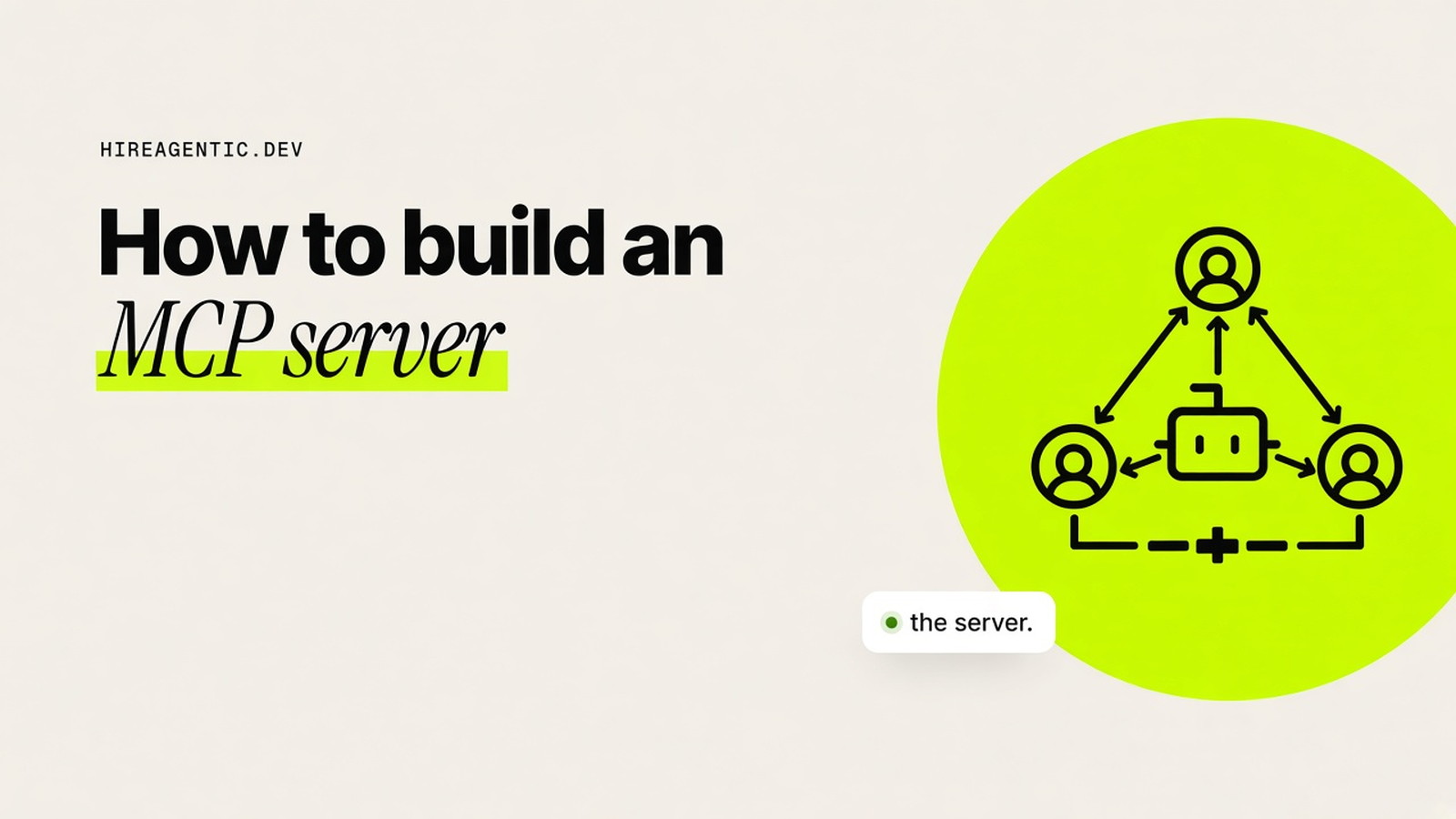
If you want the smallest server that actually runs, start with how to build an MCP server (TypeScript and Python, tested in MCP Inspector) and come back here for auth, idempotency, and the failure modes. The minimal production MCP server is about 80 lines of TypeScript and three pieces of infra: the server itself, an auth layer, and a logging layer. Skip any of the three and you will rebuild it within a month.
The skeleton looks like this. The server registers a tool, declares its input schema, and handles the call. Auth is bolted on at the transport layer (an Express middleware, an API gateway, or stdio with a mounted secret). Logging captures every call, every input, and every output to whatever observability stack you already use.
The first 80 lines are easy. The next 800 are where production lives - retries, idempotency, schema versioning, partial failures, structured errors, deprecation warnings. That is where vendor docs end and where I spend most of my time with clients.
What Production MCP Looks Like
3x
tool reuse across agents after MCP migration
40%
reduction in agent code per project (tools live elsewhere)
15-30ms
added latency per MCP call vs in-process function calling
1 day
to swap GPT-4o for Claude on an MCP-based agent
Auth, Rate Limits, and the Failure Modes Nobody Warns You About
As of protocol revision 2026-07-28, HTTP authorization is specified. A protected MCP server is an OAuth 2.1 resource server: it verifies bearer tokens and does not issue them. Stdio still reads credentials from the environment. The working Python and TypeScript gates are in how to add authentication to an MCP server. mTLS is a separate network control for cross-org traffic; it does not replace the bearer check the spec requires on HTTP.
Rate limiting is more important than people expect. An LLM that decides to call your tool 200 times in a loop is a real outage vector. Put rate limits at the server, not just the client. Idempotency keys on action servers turn "the agent retried and now we charged the customer twice" into "the agent retried and nothing happened."
The two failure modes I see most often: schema drift (an MCP server changes its input schema and silently breaks every agent) and timeout cascades (one slow MCP server locks up every agent that calls it). Versioned schemas and per-call timeouts solve both. Neither is in the default templates.
Real-World: A Five-Agent Internal Stack on MCP
A SaaS client had five internal agents - support, sales-research, billing-ops, content, and onboarding - each with its own duplicated copy of a Salesforce integration, a Postgres connector, and a Slack-send tool. Total: 15 nearly-identical tool implementations, three slightly different bug profiles, and one team that was scared to upgrade anything. We extracted three MCP servers (Salesforce, internal-data, Slack) and rewired the agents in two weeks. Tool code dropped from 4,200 lines to 1,400. The team shipped two new agents in the following month because tool reuse was now free.
5 Mistakes Teams Make in Their First MCP Rollout
1. Building one mega-server. Bundling unrelated tools into one server creates blast-radius coupling. Split by domain, not by convenience.
2. No idempotency on action servers. LLMs retry. Without idempotency keys, retries become duplicate writes. Every action server needs them.
3. Treating MCP as a framework. It is a protocol. Do not bring framework-style abstractions into your server code - keep handlers thin and explicit.
4. Skipping schema versioning. The first time you change a tool's input schema, every agent calling it can break silently. Version schemas from day one.
5. No timeout per call. One slow MCP server can block every agent that calls it. Set per-call timeouts and circuit breakers.
Frequently Asked Questions
Can MCP replace my RAG pipeline?
Partially. MCP can expose your retrieval layer as a data server that any agent can call. The retrieval, embedding, and reranking logic still lives behind the MCP - MCP is the doorway, not the room. Most teams put their retrieval behind an MCP and keep the embedding pipeline separate.
Does MCP work with non-Anthropic models?
Yes. MCP is open and model-agnostic. OpenAI, Google, Mistral, and most open models can be wired to MCP servers via simple adapters. The protocol does not assume a vendor.
MCP vs OpenAPI - is MCP just another API spec?
Related but different. OpenAPI describes HTTP endpoints for human or code clients. MCP describes tools and resources for LLM clients, with built-in concepts like tool descriptions, input schemas, and resource discovery that LLMs need. You can wrap an OpenAPI service as an MCP server (and many teams do).
What does MCP cost to run?
The server itself is cheap - a small container or serverless function. The real cost is operational discipline: monitoring, versioning, deprecation. Budget half an engineer per quarter to keep a fleet of 5-10 MCP servers healthy.
Should I expose MCP servers to third parties?
Eventually yes, but not in your first rollout. Start internal. Once your auth, rate limiting, and observability are battle-tested, then think about external exposure. The teams that go external too early end up rebuilding everything for security review.
Conclusion
MCP is the protocol that lets AI engineering finally stop reinventing the same five integrations. The teams that internalize the data/action/context taxonomy, that treat servers like microservices, and that build the boring auth-and-versioning plumbing are the ones who ship faster every quarter while their competitors keep rewriting tools.
If you are scoping your first MCP rollout and want a second pair of eyes on the server boundaries, happy to whiteboard it in a free 30-minute call.
Planning an MCP Rollout?
Free 30-minute scoping call. We will sketch the server taxonomy and the auth pattern that fits your stack.
Book a Scoping CallContinue reading
All articles